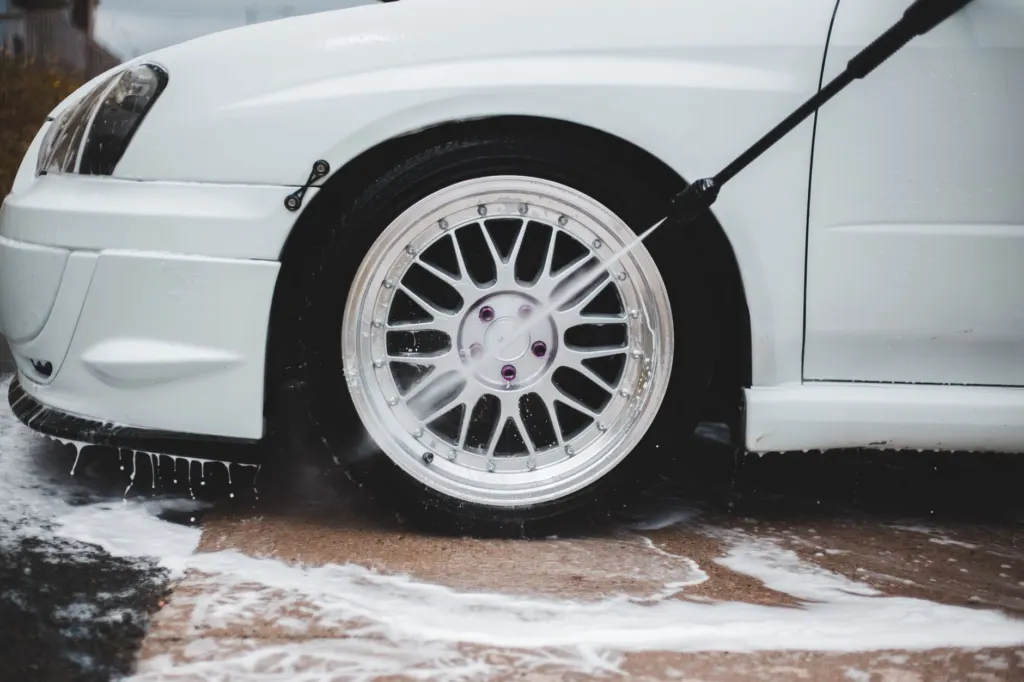
For most UK homes, the best pressure washer is a corded electric model of about 130 to 145 bar, ideally with a patio cleaner. That covers a car, bikes, garden furniture and a patio. A battery model suits light rinsing away from a socket, while petrol is for big drives and trade work.
What makes the best pressure washer for your jobs
Two figures matter most. Pressure, shown in bar, decides how hard the water hits. Flow rate, shown in litres per hour, decides how quickly dirt is rinsed away. However, more is not always better, because high pressure can damage soft wood, render and car paint.
| Main job | What to look for |
|---|---|
| Car, bikes, garden furniture | Lower pressure, a wide fan nozzle and a foam lance |
| Small patio or path | Mid-range pressure and a rotary (turbo) nozzle |
| Large patio or driveway | Higher pressure, good flow rate and a patio surface cleaner |
| Softwood decking | Moderate pressure, used at a distance with a fan nozzle |
Which? (November 2026) sorts pressure washers into three duty levels. Light duty is under 90 bar, medium duty 100 to 130 bar and heavy duty 130 to 150 bar. A “3000 psi” model is roughly 207 bar (1 bar is about 14.5 psi), so it is well above even the heavy-duty band. For a car, use a gentle setting and keep the lance well back from the paint.
How pressure washer sizes compare: Kärcher K 2 to K 7
Kärcher’s own table shows how its home pressure washer classes compare (Kärcher UK, 22 November 2026).
| Class | Max pressure | Area per hour | Hose | Jobs Kärcher adds |
|---|---|---|---|---|
| K 2 | 110 bar | 20 m² | 3 to 5 m | Garden furniture, tools, bins, terrace and balcony |
| K 3 | 120 bar | 25 m² | 5 to 7 m | Motorbikes, fences |
| K 4 | 130 bar | 30 m² | 6 to 8 m | Cars |
| K 5 | 145 bar | 40 m² | 8 to 10 m | Outside steps and paths |
| K 6 | 160 bar | 50 m² | 8 to 10 m | Mobile homes |
| K 7 | 180 bar | 60 m² | 10 m | Pools, boats, house walls |
So which Kärcher is best value? Pick the lowest class that lists your main job, then check its area figure. For example, a 30 m² patio is about an hour’s work for a K 4, or 45 minutes for a K 5. Kärcher calls its K 2 Start Plus “the ideal solution for occasional cleaning tasks”, while the K 5 Classic is “ideally suited to regular use when tackling moderate dirt”. Real time depends on how dirty the surface is.
Corded, battery or petrol?
- Corded electric: the usual choice for homes. Steady power and no fuel, but you need a socket nearby.
- Battery: handy for cars and bikes away from a socket, but pressure is much lower and the battery limits run time.
- Petrol: powerful and fully portable, so they suit big driveways and trade use. They are also louder, heavier and need servicing.
Features worth paying for
- Hose reel and long hose: saves moving the machine around.
- Adjustable lance: lets you change the spray without swapping nozzles.
- Patio cleaner attachment: gives an even finish on flat paving and cuts splashback onto walls and windows.
- Water-cooled motor: Kärcher says the one in its K 7 Comfort Premium lasts “at least 2 times longer” than a comparable universal motor.
- Water suction: lets the machine draw from a water butt via a suction hose. Kärcher lists it for the K 5 Classic, not the K 2 Start Plus.
- Good parts support: check that hoses, lances and nozzles are easy to buy later.
Checklist before you buy
- Measure the area you clean most often, then compare it with the area-per-hour figure.
- Check the hose and cable lengths together; you should not need an extension lead.
- If you must use one, choose a lead made for outdoor use and fully unwind any cable reel.
- Use an RCD with all outdoor electrical equipment; a plug-in RCD works if your fusebox has none.
- Look at the noise and weight figures if you have close neighbours or steps to climb.
- Check for a hosepipe ban in a dry summer. In England and Wales, a ban can stop you using a hosepipe to clean cars, walls, paths and patios (Water Industry Act 1991, section 76).
Water and electricity need care, so keep plugs and connections off wet ground. Electrical Safety First’s garden safety advice also says to unplug a tool before cleaning or adjusting it.
Are battery pressure washers any good?
They are good for light jobs such as rinsing a car, bikes or muddy boots. Some can draw water from a bucket, so they also work where there is no outside tap. However, most will not clean a mossy patio as well as a mains model. Ryobi’s 18V RY18PWX41A, for example, peaks at 41 bar, against 110 bar for Kärcher’s smallest mains class. It runs up to 22 minutes on high with a 5.0Ah battery. If you already own a battery tool system, check whether the same batteries fit, because that cuts the cost.
Clearing leaves before washing a patio saves time, so see our guide to the best leaf blower. If you are choosing a whole tool brand, compare DeWalt vs Makita first.