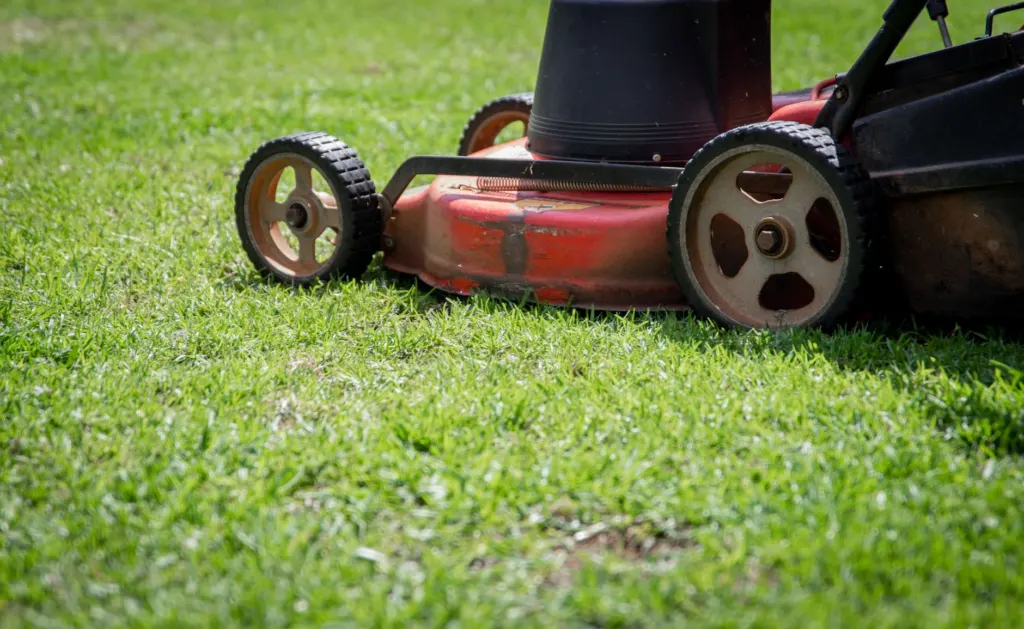
The main types of lawn mower are rotary, cylinder, hover, robotic and ride-on. For most UK gardens a rotary is the safest choice, because it copes with longer grass and bumpy ground. Choose a cylinder for a flat, fine lawn or a hover for slopes. A robot saves time, while a ride-on suits very large areas.
The main types of lawn mower compared
| Type | How it cuts | Best for | Watch out for |
|---|---|---|---|
| Rotary | One blade spins flat under a deck | Most lawns, longer grass, bumps | Coarser cut; stripes only with a rear roller |
| Cylinder | Spiral blades snip like scissors | Flat, fine lawns, stripes, very short cuts | Long grass and uneven ground |
| Hover | A rotary blade on a cushion of air | Small lawns, slopes and banks | Some models do not collect clippings |
| Robotic | Mows by itself on a schedule | Busy owners with simple layouts | Price, set-up, edges still to trim |
| Ride-on | You sit and drive | Very large lawns and paddocks | Price, storage space, servicing |
The RHS lawn mowing guide says a rotary or hover mower is usually ideal for a typical, well-used lawn.
Rotary vs cylinder mowers
A rotary mower cuts by impact, with one blade spinning at high speed. Its cut is not as fine as a cylinder’s. However, it handles longer grass and uneven lawns much better, so it suits most gardens. For stripes, pick one with a rear roller, because wheeled rotaries do not stripe well.
A cylinder mower spins a reel of blades against a fixed bottom blade. It gives the cleanest cut and can mow very short, so it suits fine lawns and sports turf. Fine lawns need mowing often, though, and cylinders cope poorly with long grass and bumps.
Push mowers: manual or self-propelled?
The old-style push mowers many people remember are manual cylinder mowers, also called reel mowers. Edwin Budding of Stroud, Gloucestershire, invented the lawn mower in 1830, and his machine was pushed from behind. Manual versions are still sold. They have no motor, so they are quiet and need no fuel or charging. Bosch, for example, says motorless push mowers suit very small lawns that are mown often.
Today “push mower” also means any powered walk-behind mower that you push yourself. A self-propelled mower drives its own wheels instead, so you only steer. That helps on large lawns and gentle slopes, although it adds weight and cost.
Hover mowers
A hover mower is a rotary that floats on a cushion of air instead of wheels. It moves in any direction, so it suits small lawns, slopes and banks. Hovers also cope with fairly rough grass. If the grass is long, cut narrower strips so the blade does not clog. Some models only cut, while others collect clippings in a box.
Robotic mowers: are they worth it?
A robotic mower trims the lawn on a schedule and leaves the fine clippings in the turf. Many follow a boundary wire laid round the lawn edge. Wire-free models instead find their way by satellite (RTK GPS) or cameras. For example, Bosch’s camera-guided VISIMOW18V is rated for lawns up to 200 m².
The RHS warns that robots can be costly and that set-up can cause headaches. Slope ratings also vary: Husqvarna’s UK range runs from 20% to 65% (checked November 2026). So check the maximum lawn area and slope against your garden, and ask about theft protection. You may still need to trim the edges.
Ride-on mowers and lawn tractors
Ride-ons are really just for very large lawns, the RHS says. Lawn tractors are the most common kind. Rear-engine riders are more compact, while zero-turn mowers pivot on the spot around trees and beds. Husqvarna’s garden tractors cut 95 to 122cm wide, and some collect or mulch the clippings.
Petrol, corded or cordless?
- Corded: light and cheap to run, but the cable limits range. Use a socket with RCD (residual current device) protection.
- Cordless: quiet, no cable and easy to start. However, battery size decides how much you can cut per charge.
- Petrol: the most stamina for big lawns, but noisier and in need of servicing. Check whether yours can run on E10 fuel; the GOV.UK E10 guide names lawnmowers as machines that may not be compatible.
What size mower do I need?
Cutting width matters more than motor size. A wider mower covers ground faster, but it is heavier and harder to store. Bosch’s ratings for its cordless rotaries give a rough guide (checked November 2026):
- Small lawn, up to about 150-200 m²: 32-34cm.
- Average back garden, up to about 500-600 m²: 38-43cm.
- Larger lawn: 44cm or more, ideally self-propelled.
- Very large areas: a ride-on or a large robotic model.
Our best lawn mower guide covers the features worth paying for, such as the grass box, mulching and height adjustment.
Checklist for choosing between the types of lawn mower
- Measure the lawn (length × width in metres) and note slopes, bumps and tight corners.
- Decide on the finish: everyday tidy, stripes, or a fine, very short cut.
- Pick the type first, then the cutting width.
- Choose the power source by lawn size and distance from a socket.
- Check the weight and folded size if storage is tight.
- Look up blade and battery replacement costs.
For borders, see our guide to the best hedge trimmer, and for autumn leaves the best leaf blower.