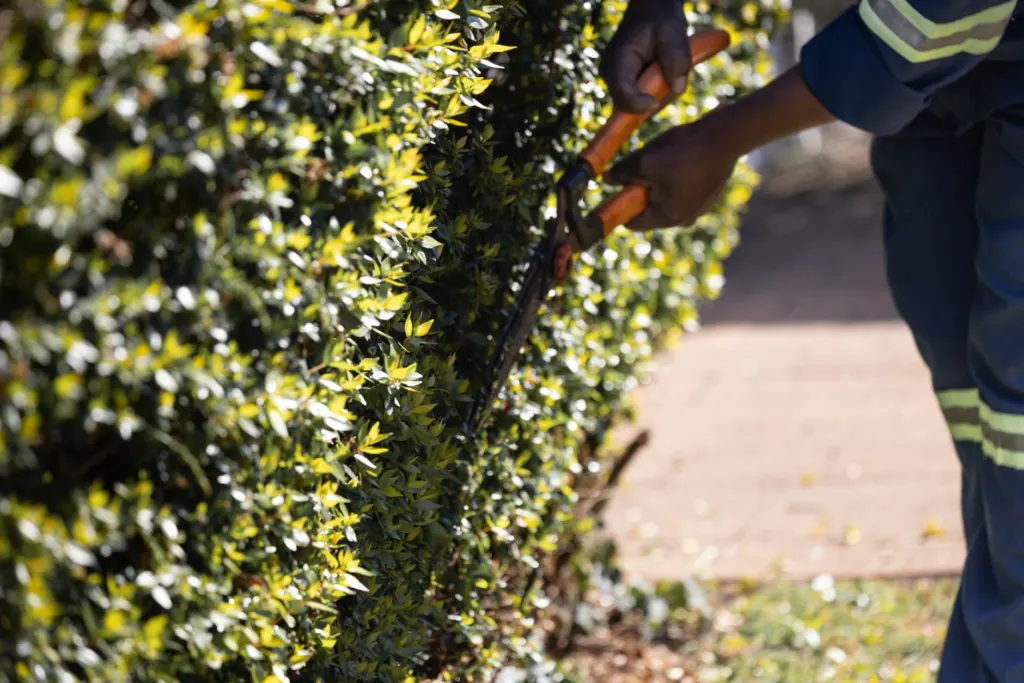
For most UK gardens, the best hedge trimmer is an 18V cordless model with a 50 to 60cm blade. It should cut stems of about 20mm or more. Small box hedges need something lighter, while old, tall or long hedges need more reach and power. This guide explains the figures that matter and compares current models, so you can match the trimmer to your hedges.
Figures that decide the best hedge trimmer
| Feature | What it means | Tip |
|---|---|---|
| Blade length | How much hedge you cut per pass | Longer reaches further but is heavier |
| Cutting capacity | The thickest stem it will cut | Also called tooth gap or blade opening; wider suits older, woody hedges |
| Weight | How long you can hold it | Makers often quote it without the battery, so check it with one fitted |
| Blade type | Single or double sided | Double sided cuts in both directions |
As a guide, Bosch sorts its trimmers into blades up to 45cm for easy jobs, 45 to 55cm for medium hedges and 65cm for old, large hedges. Read spec sheets carefully, though. For the DUH506, Makita lists a 30mm tooth spacing and a 20mm maximum blade opening, so compare the 20mm figure with other makers’ cutting capacity.
Which is the best hedge trimmer on the market?
No single model is number one for every garden, because hedges vary and review sites rank different trimmers. Instead, shortlist by blade length and cutting capacity. These current models are compared on their makers’ UK figures, checked in November 2026.
| Model | Battery | Blade | Cuts up to | Weight without battery | Good for |
|---|---|---|---|---|---|
| STIHL HSA 30 | AS (11V) | 45cm | 8mm | Not stated | Box hedges and soft new growth |
| Bosch UniversalHedgeCut 18V-50 | 18V Power for All | 50cm | 20mm | 2.6kg | Medium hedges such as privet, laurel and beech |
| Makita DUH506 | 18V LXT | 50cm | 20mm | 2.2kg | Medium hedges |
| Ryobi RY18HT55A | 18V ONE+ | 55cm | 24mm | 2.4kg | Longer garden hedges |
| Ryobi RY18HTX60A (brushless) | 18V ONE+ | 60cm | 26mm | 2.5kg | Long or woody hedges |
| Bosch AdvancedHedgeCut 36V-65-28 | 36V Power for All | 65cm | 28mm | 3.5kg | Old and large hedges |
Most of these are sold as bare tools, so budget for a battery and charger if you do not own them. The battery adds weight too: Ryobi gives 2.4kg for the RY18HT55A alone and 2.8kg with a battery.
Battery, corded or petrol?
- Battery: quiet, no cable and light. Most gardens need nothing more, if the battery lasts the job.
- Corded: cheap and powerful, but cutting the cable is a real risk. Keep it over your shoulder, plug in through an RCD and do not use it in the wet.
- Petrol: strong and portable for large hedges, but loud, heavy and higher maintenance.
- Long-reach (pole) trimmers: safer than ladders for tall hedges, because you stay on the ground.
Will a hedge trimmer cut through thick branches?
Only up to its cutting capacity. If a stem is thicker, forcing it jams the blade and can damage the teeth. Instead, cut thick branches with loppers or a pruning saw, then trim the face. For large-leaved hedges such as cherry laurel, use secateurs or loppers if you have time, because trimmers leave untidy cut leaves.
Hand shears or a powered trimmer?
Hand shears suit small hedges and soft growth. For a short run of box or privet, they can be quicker than getting a power tool out. However, for anything longer than a few metres, a powered trimmer saves a lot of time and effort.
Checklist: safe and legal hedge cutting
- Check the hedge for active nests first. In England and Wales it is an offence to intentionally take, damage or destroy a wild bird’s nest while it is in use or being built, under the Wildlife and Countryside Act 1981. Scotland’s version and the Wildlife (Northern Ireland) Order 1985 also cover reckless damage.
- Avoid major cutting from early March to early August, the main nesting season in the RHS guide on how to trim a hedge. If you find an active nest, wait until the young have fledged.
- Wear safety goggles and thick gloves.
- Use a stable platform or tripod ladder, and avoid holding a powered trimmer above shoulder height.
- Clean and oil the blades after use, so they cut cleanly.
Getting a straight, even cut
- Cut the sides first, sweeping in arcs from the bottom up with the blade parallel to the hedge. Then do the top.
- Make the base slightly wider than the top, because that lets light reach the lower leaves.
- For a level top, tie a string line between two canes about 1cm below the height you want.
- Lay a sheet along the base to catch clippings, so clearing up is faster.
Which brand?
Garden brands and the big power-tool brands all make good trimmers. If you already own cordless tools, choosing a trimmer from the same battery system saves money. Our DeWalt vs Makita comparison covers two of the widest ranges. For the lawn, read types of lawn mower and our guide to the best lawn mower.