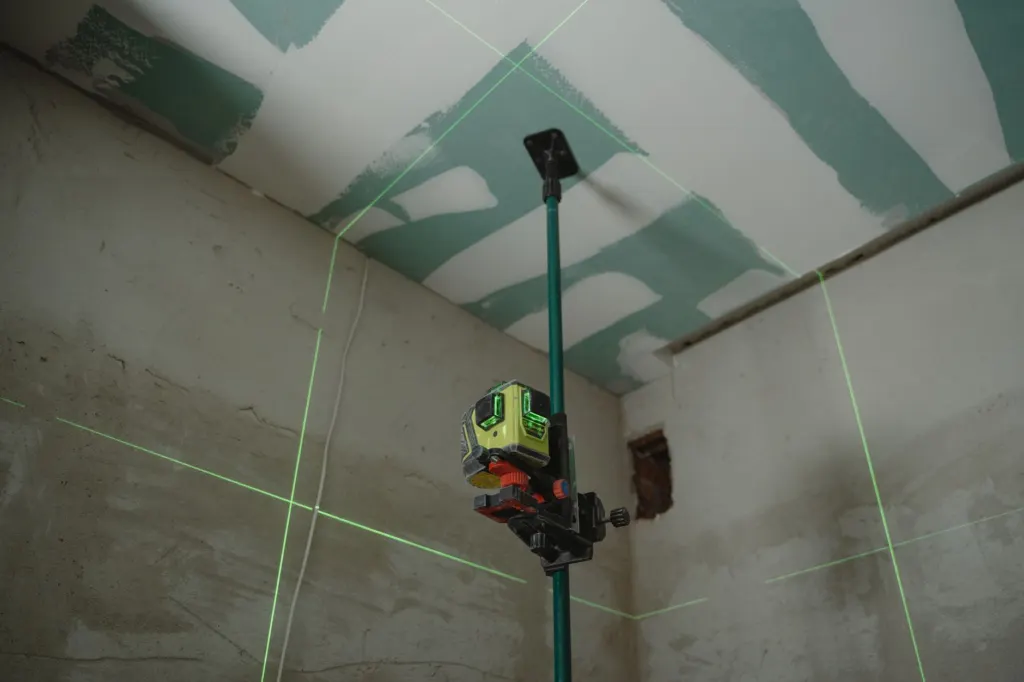
The best laser level for most DIY and trade work inside a house is a self-levelling cross-line laser. Look for an accuracy of about ±0.3mm/m or better. If you work in bright rooms, a green beam is easier to see. Outdoors or across big spaces, a rotary laser with a detector does the job better.
Types of laser level
| Type | What it projects | Good for |
|---|---|---|
| Cross-line | One horizontal and one vertical line | Shelves, tiles, pictures, kitchens |
| Multi-line (360°) | Lines all the way round a room | Ceilings, partitions, full-room work |
| Dot / plumb | Points above and below | Transferring points floor to ceiling |
| Rotary | A spinning beam, often with a detector | Groundworks, fences, large sites |
Red or green: which colour is best?
For the same power, green light looks brighter to the human eye than red. So a green line is easier to see in daylight and across larger rooms. However, that brightness costs battery life. Makita sells the same 12V cross-line laser in both colours, and its own figures show the trade-off.
| Makita figure | SK105DZ (red) | SK105GDZ (green) |
|---|---|---|
| Accuracy | ±3mm over 10m | ±3mm over 10m |
| Measuring range | 35m | 35m |
| Range with receiver | 80m | 80m |
| Run time, 4.0Ah battery | 40 hours | 20 hours |
| Laser class | 2 | 2 |
Figures are from Makita UK’s product pages for the SK105DZ and SK105GDZ, checked in November 2026. For indoor work in normal light, red is fine and runs for longer. Outdoors in sun, a detector beats either colour, because it picks up the beam when you cannot see it.
Figures that matter on the best laser level
- Accuracy: given per metre (±0.3mm/m) or over 10m (±3mm/10m is the same figure). Lower is better, and the error grows with distance: at ±0.3mm/m, the line can be 1.5mm out at 5m.
- Working range: how far you can see the line, and how far it works with a detector.
- Self-levelling range: how far off level the base can sit before the laser warns you. It is ±4° on the Makita models above.
- Laser class: printed on the label. GOV.UK’s laser safety advice says Class 2 products are safe for short exposures, because we naturally avoid bright light, but they can still dazzle.
- Pendulum lock: protects the mechanism when the laser is moved.
- Battery: check run time, and whether it takes your existing cordless tool batteries.
Which laser level brand is best value?
No single brand is best for every job, so compare the figures above rather than the name on the case. The best laser level for you may be one that runs on batteries you already own, because you can then buy it body only. For example, Makita’s SK105D and SK106D lasers take its 12V max CXT batteries. To compare battery ranges, see DeWalt vs Makita and Milwaukee vs DeWalt.
For occasional DIY, a red cross-line laser covers most jobs. Pay more for green beams, 360° lines or detector use only if your work needs them.
Are laser levels legal in the UK?
Yes. Laser levels sold for building and DIY use are legal to buy and use. The warnings people read about mostly concern powerful handheld laser pointers. Even so, never look into the beam, and keep it away from children’s eyes.
Also, never point any laser at a vehicle. Under the Laser Misuse (Vehicles) Act 2018, it is an offence if the beam dazzles or distracts the person in control, or is likely to. It covers vehicles that are moving or ready to move, and the Act counts anything used for travel by land, water or air.
How to check a laser level is accurate
A knock can upset calibration, so check the laser before an important job. You need two walls about 5m apart:
- Set the laser on a tripod or firm surface close to wall A. Let it level, then mark the centre of the cross on wall A (mark 1).
- Without moving it, turn the laser through 180 degrees. Let it level and mark the cross on wall B (mark 2).
- Move the laser close to wall B and adjust its height until the cross sits exactly on mark 2.
- Turn it through 180 degrees and mark the cross on wall A again (mark 3).
- Measure the gap between marks 1 and 3. It shows the error over 10m, there and back. If the gap is larger than the manual allows, have the laser serviced.
Checklist before you buy
- Decide indoor or outdoor, then choose line or rotary.
- Check the accuracy figure at the distances you work over.
- Look for a tripod thread and a wall bracket.
- Check that it warns you when it is out of level.
- Keep it in its case, because knocks affect calibration.
Before fixing anything to a wall, find the studs and cables with a stud finder. Then drill with the right tool, explained in cordless drill vs impact driver.