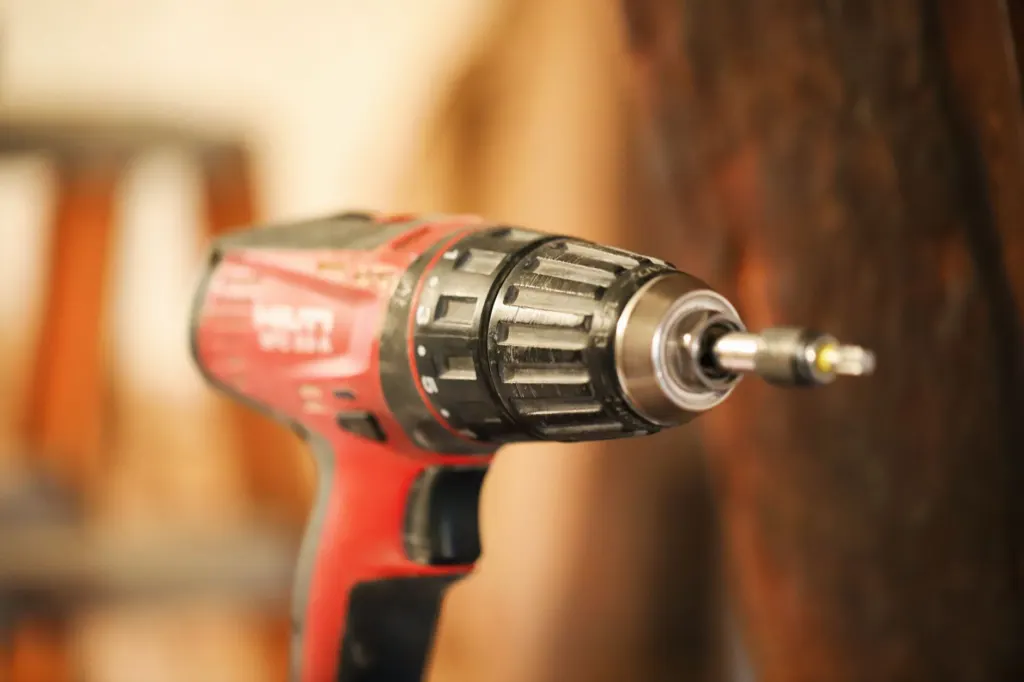
The cordless drill vs impact driver question comes down to drilling versus driving. A drill makes holes and drives small screws with control. An impact driver drives long screws and bolts quickly, with far less twist on your wrist. For most UK homes, buy a combi drill first and add an impact driver for decking, fencing or stud walls.
How they differ
| Cordless drill (drill driver) | Impact driver | |
|---|---|---|
| Bit holder | Chuck that grips round and hex bits | Quick-release 1/4″ hex socket |
| Main job | Drilling holes, careful screwing | Driving long screws and bolts |
| Torque control | Clutch with numbered settings | Power modes; no clutch on most |
| Feel | Smooth, can twist your wrist | Hammering clicks, little kickback |
| Masonry | Combi drills have a hammer mode | Not a masonry drill |
Here is the same comparison on two real 18V tools, from Makita’s UK pages for the DHP487 and DTD157 (checked November 2026). Other brands differ, so compare like with like.
| Makita DHP487 combi drill | Makita DTD157 impact driver | |
|---|---|---|
| Maximum fastening torque | 40 Nm (hard joint) | 140 Nm |
| Settings | 20 torque settings, 2 speeds | 3 power modes plus assist mode |
| Bit holder | 1.5-13 mm keyless chuck | 1/4″ hex |
| Masonry drilling | Up to 13 mm, hammer mode | None listed |
| Length, weight with battery | 164 mm, 1.4-1.7 kg | 133 mm, 1.2-1.5 kg |
| Sound pressure | 86 dB(A) | 98 dB(A) |
| Vibration, heaviest task listed | 10.5 m/s² (hammer drilling concrete) | 11.5 m/s² (impact tightening) |
So wear ear defenders with an impact driver, and take breaks with both tools in their heavy modes. The HSE’s hand-arm vibration advice names hammer drills and impact wrenches, and lists tingling or numb fingers as early signs.
Is an impact driver just a drill?
No. An impact driver turns like a drill until the screw resists, then adds rapid rotational blows. That is why the DTD157 above is rated at 140 Nm against the combi drill’s 40 Nm. However, it has no clutch on most models. Therefore, it can easily overdrive small screws or crack soft materials. Also, it only takes hex-shank bits, so drilling is limited.
Do not confuse it with an “impact drill”, a name sometimes used for a hammer drill. A hammer drill’s blows push the bit forward into brick, while an impact driver’s blows only turn it.
Where a combi drill fits in
A combi drill is a drill driver with a hammer mode. The hammer action lets it drill into brick and block, which a plain drill driver cannot do well. For most UK homes, with masonry walls, a combi drill is the better first buy, rather than a plain drill driver. For heavy concrete work, though, an SDS drill is the right tool.
Will a cordless screwdriver do instead?
Only for light jobs such as flat-pack furniture and hinges. Makita’s 3.6V DF001DW, for example, is rated at 4 Nm (hard joint) and weighs 0.36 kg. It has a 1/4″ hex bit holder rather than a chuck, and Makita lists no drilling capacity for it. So treat a screwdriver as an extra, not a replacement for a drill.
Which to buy first
- Most homes: a combi drill, because it drills wood, metal and masonry and drives screws.
- Decking, framing or fencing: add an impact driver for the long screws.
- Trades: consider a twin pack of both, because the tools share batteries and a charger. Compare its price with buying them separately.
- Already own batteries: stay with the same system and buy the tool body only.
When not to use an impact driver, and other mistakes
- Using an impact driver on small brass or chrome screws, which strips the heads.
- Drilling brick with an impact driver, or with a drill out of hammer mode, which overheats and blunts the bit.
- Setting the drill clutch too high for plasterboard screws, which breaks the paper face.
- Using worn or cheap bits, which cam out and damage the screw head.
- Forgetting to pilot-drill hardwood, so screws split the timber.
Also, use impact-rated bits in an impact driver, because ordinary bits can snap under the blows.
For small fixes away from the toolbox, a pocket tool with a bit holder can save a trip back to the van. Our guide to the best multi tool explains what to look for.
Do you need both?
Not always. A good combi drill handles most household jobs on its own. However, if you build decks, fit fences or put up stud walls, an impact driver is worth adding. With both, you keep a drill bit in one tool and a driver bit in the other, so pilot holes and screws go in without swapping bits.
Brushless or brushed?
Brushless motors have no brushes to wear out and use battery power more efficiently, so you get longer use from each charge. Their main disadvantage is price, because they need more complex control electronics. Both Makita examples above are brushless. However, a brushed model can still suit occasional DIY.
Before drilling into walls, use a stud finder to avoid cables and pipes. Choosing a battery brand? Compare Milwaukee vs DeWalt and DeWalt vs Makita.